
Building Healthy Online Relationships
Attributes to meet: PDF: Booklets, Order
Download File & Order: condition met
Booklet, 2022
Teaching young people how to build healthy relationships provides them with valuable skills that can promote their overall health. With the increasing use of online technology, teaching youth to build healthy relationships online is becoming increasingly important. This booklet provides information about how to build healthy online relationships, including information on online safety and communication, as well as tips to help navigate cyberbullying, grooming, sextortion, and more. It is designed for use with youth.
For more information on healthy relationships in general, view the booklet Building Healthy Relationships: Yes, that includes dating relationships!
Related products
-

Sexually Transmitted Infections (STIs)
Report, 2010
This report presents the results of an environmental scan of available education resources focused on the effects of STIs, and their impact on fertility, pregnancy, and the newborn. Included is a preliminary assessment of the needs of health and allied health professionals in Saskatchewan for resources in this area.
SKU: 7-502 -

Sexual Health Development Chart
Flipchart, Revised 2024
This resource is aimed at health professionals and childcare providers. It provides information and messages to promote sexual health in their interactions with children and families and to support parents as sexual health educators. The flipchart includes information for five age groups: Birth to Two Years; Two to Five Years; Five to Eight Years; Nine to Twelve Years; Thirteen to Sixteen Years.
SKU: 7-203 -
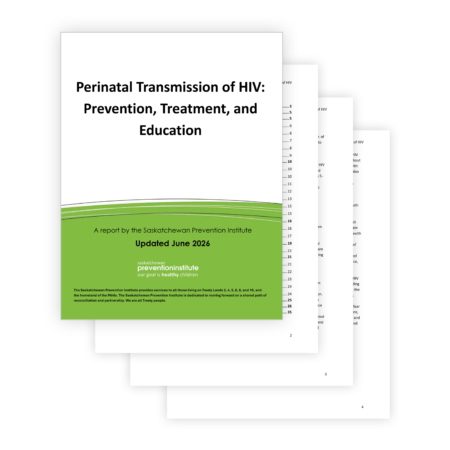
Perinatal Transmission of HIV: Prevention, Treatment, and Education
Report, Updated 2026
Saskatchewan continues to see high rates of new cases of human immunodeficiency virus (HIV) infection in comparison to the rest of Canada. A large number of these new cases are being identified in women of childbearing age.
Recognizing the importance of understanding HIV in the context of pregnancy, the Saskatchewan Prevention Institute conducted a review of the literature in this area. The review includes findings and recommendations on perinatal transmission, transmission prevention, barriers to prevention, and health promotion around these topics.
SKU: 7-501 -
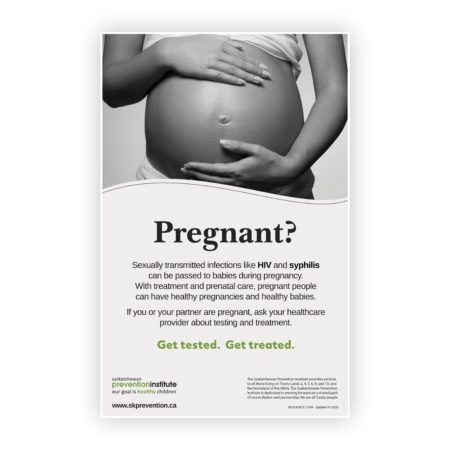
Pregnant? Get tested for HIV and Syphilis
Poster, 2026
HIV and syphilis can be passed from a pregnant person to their growing baby during pregnancy. This poster brings awareness to the importance of testing, treatment, and prenatal care for the health of pregnant people and their babies.
SKU: 7-004