
Late Preterm Infant (Near-Term)
Attributes to meet: PDF: Download File, Fact Sheets
Download File: condition met
Fact Sheet, 2023
A late preterm infant is a baby that is born between 34-36 (almost 37) weeks of pregnancy. This fact sheet provides information about some health problems that might affect a late preterm infant, things that caregivers and parents should watch for, and some questions to be discussed before leaving the hospital.
Related products
-

HIV and Pregnancy – A Guide to Care
Guide and Manual, Revised 2020
This guide covers such topics such as HIV/AIDS in Saskatchewan, modes of transmission of HIV, HIV testing during pregnancy, prenatal algorithm, HIV treatment and drug management, after-care for babies of HIV positive women, barriers to HIV transmission prevention and prenatal care, and motivational approaches.
For updated information about HIV/AIDS for health professionals, visit: https://www.canada.ca/en/public-health/services/diseases/hiv-aids/health-professionals.html.
For updated HIV order sets for Saskatchewan, including maternal and infant order sets, clinical forms, and discharge checklists, visit: https://www.saskhealthauthority.ca/intranet/health-provider-resources/clinical-resources/z-list-clinical-resources/maternalchildrens-health-resources/hiv-maternal-and-newborn-clinical-resources.
For updated information about infant feeding recommendations in Canada, including criteria for people living with HIV who want to breastfeed, visit: https://pubmed.ncbi.nlm.nih.gov/37008587/.
SKU: 7-008 -

ABCs for Safe Sleep
Informational Door Hanger, 2020
This resource outlines safe sleeping tips for babies to help reduce the risk of Sudden Infant Death Syndrome (SIDS). It is intended to be used as a door hanger within a baby’s sleep environment.
SKU: 2-409 -
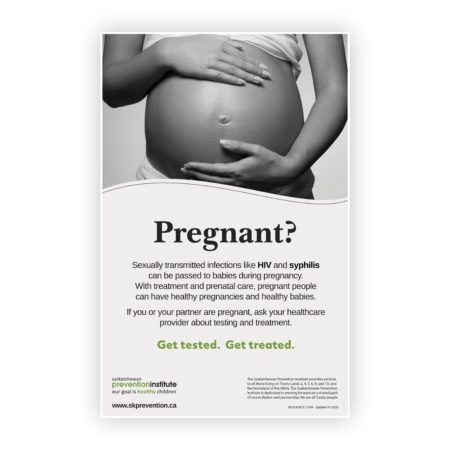
Pregnant? Get tested for HIV and Syphilis
Poster, 2026
HIV and syphilis can be passed from a pregnant person to their growing baby during pregnancy. This poster brings awareness to the importance of testing, treatment, and prenatal care for the health of pregnant people and their babies.
SKU: 7-004 -

Sexually Transmitted Infections (STIs) Executive Summary
Report, 2011
This executive summary is for the report “Sexually Transmitted Infections and Their Effects on Fertility, Pregnancy, and the Newborn: An Environmental Scan of Available Resources and a Preliminary Needs Assessment for Saskatchewan Health Care Providers”.
Download the Sexually Transmitted Infections (STIs) – ReportSKU: 7-503