

HIV and Pregnancy – A Guide to Care
Attributes to meet: PDF: Download File, Guides and Manuals
Download File: condition met
Guide and Manual, Revised 2020
This guide covers such topics such as HIV/AIDS in Saskatchewan, modes of transmission of HIV, HIV testing during pregnancy, prenatal algorithm, HIV treatment and drug management, after-care for babies of HIV positive women, barriers to HIV transmission prevention and prenatal care, and motivational approaches.
For updated information about HIV/AIDS for health professionals, visit: https://www.canada.ca/en/public-health/services/diseases/hiv-aids/health-professionals.html.
For updated HIV order sets for Saskatchewan, including maternal and infant order sets, clinical forms, and discharge checklists, visit: https://www.saskhealthauthority.ca/intranet/health-provider-resources/clinical-resources/z-list-clinical-resources/maternalchildrens-health-resources/hiv-maternal-and-newborn-clinical-resources.
For updated information about infant feeding recommendations in Canada, including criteria for people living with HIV who want to breastfeed, visit: https://pubmed.ncbi.nlm.nih.gov/37008587/.
Related products
-
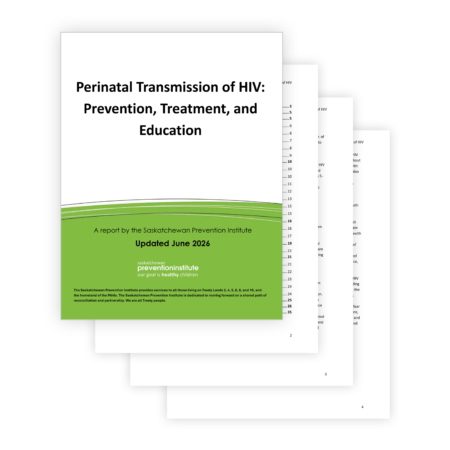
Perinatal Transmission of HIV: Prevention, Treatment, and Education
Report, Updated 2026
Saskatchewan continues to see high rates of new cases of human immunodeficiency virus (HIV) infection in comparison to the rest of Canada. A large number of these new cases are being identified in women of childbearing age.
Recognizing the importance of understanding HIV in the context of pregnancy, the Saskatchewan Prevention Institute conducted a review of the literature in this area. The review includes findings and recommendations on perinatal transmission, transmission prevention, barriers to prevention, and health promotion around these topics.
SKU: 7-501 -

Hope for the Future: Having a Healthy Pregnancy While Living with HIV
Video, 2013
This DVD shares information about HIV, pregnancy, and parenting, with the goal of showing that healthy pregnancies and healthy babies are possible for pregnant women living with HIV in Saskatchewan. The knowledge and experiences of people living with HIV and those who work in this area are shared. The DVD was created as a resource for health and allied health professionals and for people living with HIV in Saskatchewan.
SKU: 7-000 -

Routine Blood Tests in Pregnancy
Fact Sheet, 2013
As part of prenatal care, routine blood tests are recommended for all women. If these tests identify an infection or another condition, treatment can reduce the risk of harm to the pregnant woman and her baby. This fact sheet provides information on routine blood tests conducted.
SKU: 2-427 -

Maternal Mental Health
Information Card, 2013
The Maternal Mental Health Information Card provides information for women and their families and friends who want to know more about maternal depression. It includes information on symptoms of depression and who to contact for help. The card also includes ways a woman can take care of herself and suggestions for family and friends to help support her if she is suffering from depression. Contacts for help are also provided. The card is ideal for waiting rooms or as a handout to those who would benefit from information on maternal depression.
SKU: 2-101