

Abusive Head Trauma (Shaken Baby Syndrome)
Attributes to meet: PDF: Download File, Fact Sheets
Download File: condition met
Fact Sheet, Revised 2019
Explains what abusive head trauma is, including how and why it happens, the long-term effects, and how it can be prevented. Aimed at health professionals and service providers who work with families. For information aimed at caregivers, see When Your Baby Can’t Stop Crying (resource 4-902).
Related products
-

Home Safety Tips: Birth to 1 Year
Booklet, Revised 2025
All children depend on the adults around them to provide safe, healthy environments to learn, grow, and develop new skills. This booklet will support caregivers in preparing for each stage of child development, to better predict and prevent injuries to children from birth to 1 year of age.
Safety tips are included on the following topics: safe sleep, coping with crying, burns, scalds, drowning, falls, choking, and car seats.
Also available: Home Safety Tips: 1 to 4 Years, and Home Safety Tips: 5 to 9 YearsSKU: 4-023 -
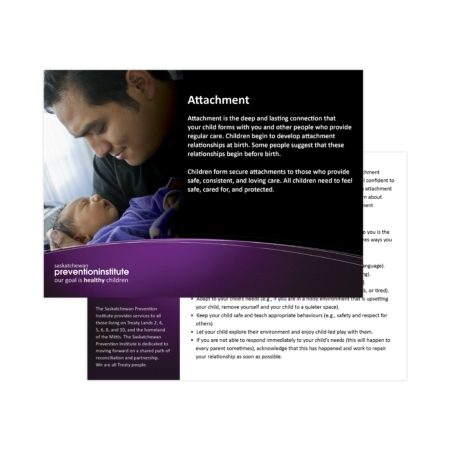
Attachment
Information Card, Updated 2026
Written in plain language, this information card provides basic information about attachment … the connection that a baby forms with his caregivers that helps him to feel loved, secure, and safe.
SKU: 8-801 -

Home Safety Tips: 1 to 4 Years
Booklet, Revised 2025
All children depend on the adults around them to provide safe, healthy environments to learn, grow, and develop new skills. This booklet will support caregivers in preparing for each stage of child development, to better predict and prevent injuries to children from 1 to 4 years of age.
Safety tips are organized by activity, and address the following topics: safe sleep, drowning, burns, scalds, choking, poisoning, bike and wheel safety, car seats, and pedestrian safety.
Also available: Home Safety Tips: Birth to 1 Year, and Home Safety Tips: 5 to 9 YearsSKU: 4-024 -

Preventing Injuries
Fact Sheet, 2010
Injuries are the leading cause of death for Saskatchewan children. This fact sheet defines the differences between injuries and “accidents,” outlines the causes of injuries, and identifies the different types of strategies that can be used to prevent injuries.
SKU: 4-003