

Gestational Diabetes Risks Prevention and Treatments
Attributes to meet: PDF: Download File, Reports
Download File: condition met
Literature Review, 2020
Gestational diabetes, also known as gestational diabetes mellitus (GDM), is a sub-type of diabetes that is first identified during pregnancy. It consists of abnormal glucose tolerance or higher than normal blood glucose levels, that may or may not diminish following the birth of an infant. Over the past decades, GDM rates have continued to increase in Canada. This review provides information on the risk factors for developing GDM, its impact on maternal and offspring health, the approach to screening and diagnosis, recommended management strategies (both pharmacological and non-pharmacological), as well as primary prevention strategies.
Related products
-

Common Non-prescription Medications in Pregnancy
Fact Sheet, Revised 2021
Non-prescription medications, sometimes referred to as over-the-counter or OTC medications, are those that can be purchased without having a doctor’s prescription. This fact sheet provides information on common OTC medications such as antacids, antihistamines, laxatives, cough and cold medications, herbal products, and many more that are used in pregnancy.
SKU: 2-251 -

Prenatal eHealth Tools Report
Report, 2016
Expectant parents today have access to a wealth of information on pregnancy and childbirth, and much of that information is accessed electronically. Knowledgeable healthcare providers who understand the strengths and limitations of these new technologies are in an excellent position to offer expert guidance to women using these technology-based prenatal health tools. This report seeks to educate interested stakeholders about eHealth, what it entails, the potential benefits and challenges, and recommended options for using eHealth to provide quality prenatal information to residents of Saskatchewan.
SKU: 2-901 -

Group Prenatal Care Lit Review
Report, 2016
Group prenatal care is a model of group where eight to twelve women of similar gestational age meet as a group with their healthcare provider for 90-120 minutes of regularly scheduled appointments, starting in their second trimester and continuing throughout their pregnancy. During these appointments, each woman has a brief individual physical assessment with the healthcare provider and then participates in a group discussion led by a healthcare provider. All prenatal care is provided in this group setting, combining the usual physical assessment with peer support and increased time for education about healthy pregnancy. This report examines current research on group prenatal care to assess if it is a good model of care for Saskatchewan and if there is an improvement in birth outcomes and breastfeeding rates associated with using this model of care compared to individual prenatal care. Birth outcomes examined in this report are gestational age at birth, preterm birth, and low birth weight.
SKU: 2-903 -
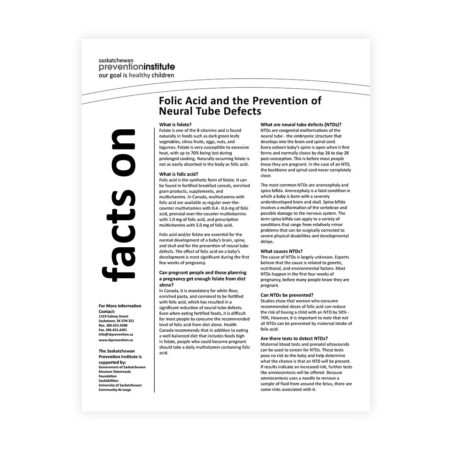
Folic Acid and the Prevention of Neural Tube Defects
Fact Sheet, Updated 2026
This fact sheet provides information on neural tube defects (NTDs) and folic acid. It includes information about what NTDs are, the importance of taking folic acid before and during pregnancy, classification of risk level, and appropriate folic acid dosage.
SKU: 2-301