
Late Preterm Infant (Near-Term)
Attributes to meet: PDF: Download File, Fact Sheets
Download File: condition met
Fact Sheet, 2023
A late preterm infant is a baby that is born between 34-36 (almost 37) weeks of pregnancy. This fact sheet provides information about some health problems that might affect a late preterm infant, things that caregivers and parents should watch for, and some questions to be discussed before leaving the hospital.
Related products
-
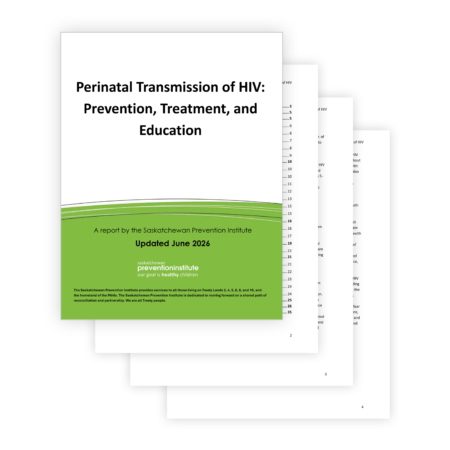
Perinatal Transmission of HIV: Prevention, Treatment, and Education
Report, Updated 2026
Saskatchewan continues to see high rates of new cases of human immunodeficiency virus (HIV) infection in comparison to the rest of Canada. A large number of these new cases are being identified in women of childbearing age.
Recognizing the importance of understanding HIV in the context of pregnancy, the Saskatchewan Prevention Institute conducted a review of the literature in this area. The review includes findings and recommendations on perinatal transmission, transmission prevention, barriers to prevention, and health promotion around these topics.
SKU: 7-501 -

HIV, Pregnancy, and Tobacco Use
Fact Sheet, Revised 2024
This fact sheet explains that for women living with HIV, smoking tobacco during pregnancy can increase the chances that HIV will be passed to the baby. Information about traditional tobacco use is included, along with resources to help pregnant women and those planning a pregnancy to quit or reduce their tobacco use.
SKU: 7-515 -

Group Prenatal Care Lit Review
Report, 2016
Group prenatal care is a model of group where eight to twelve women of similar gestational age meet as a group with their healthcare provider for 90-120 minutes of regularly scheduled appointments, starting in their second trimester and continuing throughout their pregnancy. During these appointments, each woman has a brief individual physical assessment with the healthcare provider and then participates in a group discussion led by a healthcare provider. All prenatal care is provided in this group setting, combining the usual physical assessment with peer support and increased time for education about healthy pregnancy. This report examines current research on group prenatal care to assess if it is a good model of care for Saskatchewan and if there is an improvement in birth outcomes and breastfeeding rates associated with using this model of care compared to individual prenatal care. Birth outcomes examined in this report are gestational age at birth, preterm birth, and low birth weight.
SKU: 2-903 -

HIV, Pregnancy, and Tobacco Use
Poster, 2023
This poster explains that for women living with HIV, smoking tobacco during pregnancy can increase the chances that HIV will be passed to the baby. Supports are listed to help pregnant women and those planning a pregnancy to quit or reduce their tobacco use.
SKU: 7-517