
Prenatal Supplements
Attributes to meet: PDF: Infographics, Order
Download File & Order: condition met
Infographic, 2025
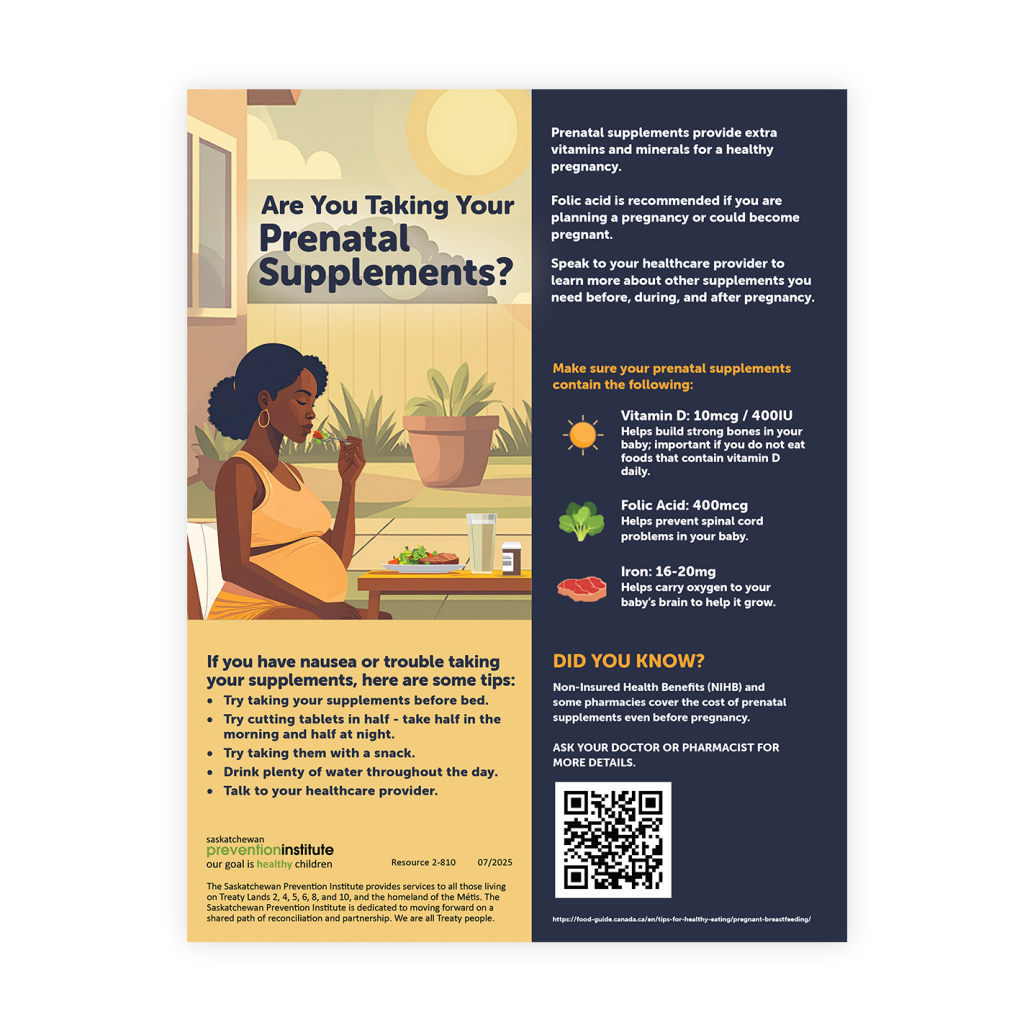
Developed in collaboration with the Perinatal Nutrients of Concern Resource Development Working Group, this infographic poster highlights key nutrients to look for in a prenatal supplement, including folic acid, vitamin D, and iron. It includes tips for managing common challenges with taking supplements, such as nausea or difficulty swallowing.
Related products
-

Folic Acid and the Prevention of Neural Tube Defects
Fact Sheet, 2016
Provides information on neural tube defects and the importance of taking folic acid before becoming pregnant.
SKU: 2-301 -

Before You Become Pregnant
Brochure, Revised 2022
This brochure talks about the important information a woman should know when planning a pregnancy. It promotes a healthy lifestyle prior to conception in order to ensure the healthiest baby possible.
SKU: 2-309 -

HIV and Pregnancy – A Guide to Care
Guide and Manual, Revised 2020
This guide covers such topics such as HIV/AIDS in Saskatchewan, modes of transmission of HIV, HIV testing during pregnancy, prenatal algorithm, HIV treatment and drug management, after-care for babies of HIV positive women, barriers to HIV transmission prevention and prenatal care, and motivational approaches.
For updated information about HIV/AIDS for health professionals, visit: https://www.canada.ca/en/public-health/services/diseases/hiv-aids/health-professionals.html.
For updated HIV order sets for Saskatchewan, including maternal and infant order sets, clinical forms, and discharge checklists, visit: https://www.saskhealthauthority.ca/intranet/health-provider-resources/clinical-resources/z-list-clinical-resources/maternalchildrens-health-resources/hiv-maternal-and-newborn-clinical-resources.
For updated information about infant feeding recommendations in Canada, including criteria for people living with HIV who want to breastfeed, visit: https://pubmed.ncbi.nlm.nih.gov/37008587/.
SKU: 7-008 -

Edinburgh Postpartum Depression Scale (EPDS) Screening and Care Guide
Guide and Manual, 2012
The EPDS Screening and Care Guide provides healthcare providers with score interpretation and care guide to use when screening pregnant and postpartum women for depression and anxiety using the Edinburgh Postpartum Depression Scale (EPDS). It also includes guidelines for medical management when maternal mental health is of concern, contact information for Saskatchewan Healthline and Saskatchewan Drug Information Services, and a space for relevant local contact information. On the reverse side of the form there is a brief description of maternal depression including common symptoms, guidelines for screening, and the EPDS questions.
* For an updated version of the Maternal Mental Health Edinburgh Postnatal Depression Scale (EPDS) Screening and Care Guide available through the Saskatchewan Ministry of Health, please visit https://www.ehealthsask.ca/services/resources/Resources/EPDS-screening-2019.pdfSKU: 2-104