Impacts of Wildfire Smoke on Health During Pregnancy, infancy, and Early Childhood
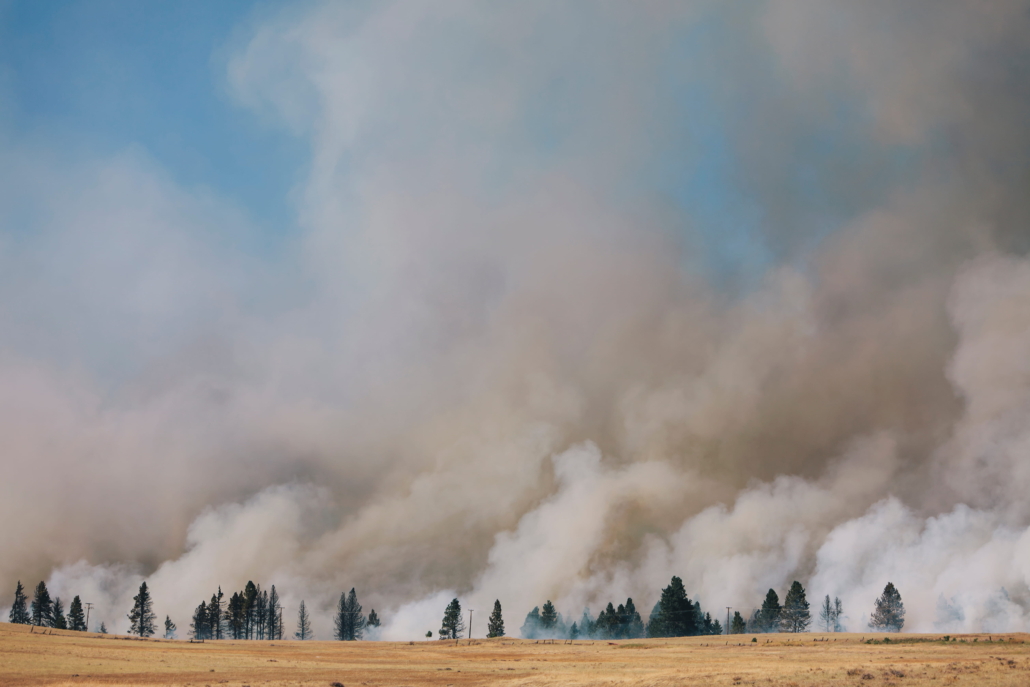
As spring and summer approach, we often think of nice sunny warm days, but we also need to consider the possibility of smoky skies from forest fires and the potential health impacts on many, including those who are pregnant, infants, and young children.
What’s in Wildfire Smoke:
Pollutants in wildfire smoke include small and ultra-tiny particles (PM2.5) and gases like carbon dioxide, nitrogen oxides, sulphur dioxide, ozone, polyaromatic hydrocarbons (PAHs), and volatile organic compounds (VOC). When forest fires involve houses and other structures, even more types of pollutants are added. Both the tiny particles and the gases can be breathed deep into the lungs and can cross into the blood stream. In pregnant women, these can cross the placental barrier to also affect the baby.
Impacts of Wildfire Smoke on Health During Pregnancy, infancy, and Early Childhood:
Health effects are greatest near to and downwind of the fire, but impacts can even occur great distances away. The most common health impacts that can affect anyone can be temporary symptoms like eye, nose and throat irritation, headaches, and a mild cough. However, more concerning symptoms could be severe cough, dizziness, chest pains, heart palpitations, or wheezing which could include asthma attacks. Certain groups are at higher risk of health impacts from wildfire smoke including infants, young children, pregnant women, older adults, and those with underlying heart or lung conditions. Prenatal exposure to smoke is associated with a higher chance of premature birth and lower birth weight which can affect the child’s development later in life.
Infants and young children breathe faster than older children and adults, and particles are less likely to be trapped in their nasal passages, so more particles and gases reach their little lungs. Children typically spend more time outdoors and are more physically active, and that increases their potential exposures to pollutants even more. Also, respiratory and immune systems are still developing in infants and young children. Pregnant women can also be more vulnerable to the effects of airborne pollutants since pregnancy can increase breathing depth and rate.
Things we can do to reduce the risk of wildfire smoke:
There are a variety of things that can be done to reduce the smoke exposure and health impacts for individuals including infants, young children, and pregnant women.
- Reducing physical activity can significantly lower your smoke exposure. Physical exertion increases one’s breathing rate so more polluted air is breathed in. Temporarily avoiding physical activity can lower the inhaled dose of pollutants. However, children staying indoors with inactivity can lead to unhappy children. Balance is needed so monitor air quality to determine when it’s OK to be outdoors and when it’s best to do things indoors. If physical activity is desired and air quality is poor, then it would be best to do be active indoors in a room with good filtration or while wearing a mask.
- Staying indoors can reduce the impact of pollutants and their health effects. Being indoors with doors and windows closed, and keeping the indoor air as clean as possible by not smoking or vacuuming (unless your vacuum cleaner has a HEPA or high efficiency particulate air filter), and not using strong smelling cleaners, incense, or candles are good steps to take. If you have an air conditioner, run it with the fresh-air intake closed (“recirculate mode”). If you need to travel outside in a vehicle, travel with the car windows closed and keep the ventilation on “recirculate” and/or wear a mask to reduce the pollutant exposure.
- Going to community “Clean Air” shelters or using air filtration at home are good options. More communities are providing clean-air shelters in public buildings like community halls, libraries, schools, malls, etc. Some public buildings may have ventilation systems with HEPA filters or use large portable air purifier units. Clean air shelters provide a space for people who don’t have ways of protecting themselves from smoke, who are living in poorly insulated homes and do not have a means of filtration.
Individual families can purchase air purifiers to have clean-air rooms in their homes. For individual homes or offices, a portable air cleaner or air purifier with HEPA (high efficiency particulate air) filters which help remove the particulates from the air and when combined with an activated carbon filter, can also help remove some harmful gases. You should avoid air purifiers that produce ozone. It is good to operate the purifier in a room where a child, pregnant woman, or other vulnerable people spend a lot of time such as a child’s bedroom at night or a playroom during the day. The higher the fan speed and the longer it runs the more air will be filtered. Follow instructions for the frequency of replacing or cleaning the filters. A DIY (Do-It-Yourself) air purifier can be put together at home using a box fan. - Wearing a mask can provide some protection from smaller smoke particles. Of the commonly used masks, a good fitting NIOSH-certified N95 masks is the most effective. There are recommendations to help ensure a good mask fit. Surgical masks work less well but they can still offer some protection. Sizing masks for children is an issue but child-sized N95 may work for children 4 to 10 years of age. For those between 2 and 4 years, regular medical masks may be the best option. For young children (less than 2 years of age) or those with disabilities who find it difficult to use a mask, the best strategies are to stay indoors and improve indoor air filtration. For pregnant women, the face shape can change slightly later in pregnancy and so re-checking the mask fit periodically is recommended.
- Staying informed about the present and forecasted air quality is useful to help protect yourself and your family from the effects of smoke. Looking at an Air quality health index (AQHI) and a FireSmoke map webpages can show you the present air quality in your area and smoke predictions over the next 24 hours based on changes in wind predictions. This can help you plan your activities and to what extent you need to provide protection for yourself and your children.
- Being prepared even before wildfire season starts can be helpful. Checking out what places or options there are in your community for clean-air shelters even before smoke becomes an issue can be useful for when smoke becomes a concern. It is good to have a well-fitting mask for each household member available so that when smoke arrives you can reduce the health impact of the smoke. If there are family members who need medications for conditions that can be made worse with smoke, like asthma, it is good to make sure you have the medication available. It is also good to consider the purchase of a HEPA air purifier to have available for when smoke becomes a problem, especially if you do not have access to clean air shelters in your community and you have vulnerable people in your household. HEPA air purifiers can be found at many department stores or online.
Additional Information and Resources:
- Wildfire Smoke and Pregnancy. BC Center for Disease Control, 2024.
- Respiratory Protection and Wildfire Smoke. BC Center for Disease Control, 2024.
- Air Quality Health Index Messages. Government of Canada.
- DIY (Do-It-Yourself) air purifier: BC Lung Association
- Recommendations to help ensure a good fit for an N95 mask: Public Health Agency of Canada
- Additional Guidance for Mask use for Infants and Children during Wildfire Smoke Events: Government of Manitoba
For further information on air quality in your area: