
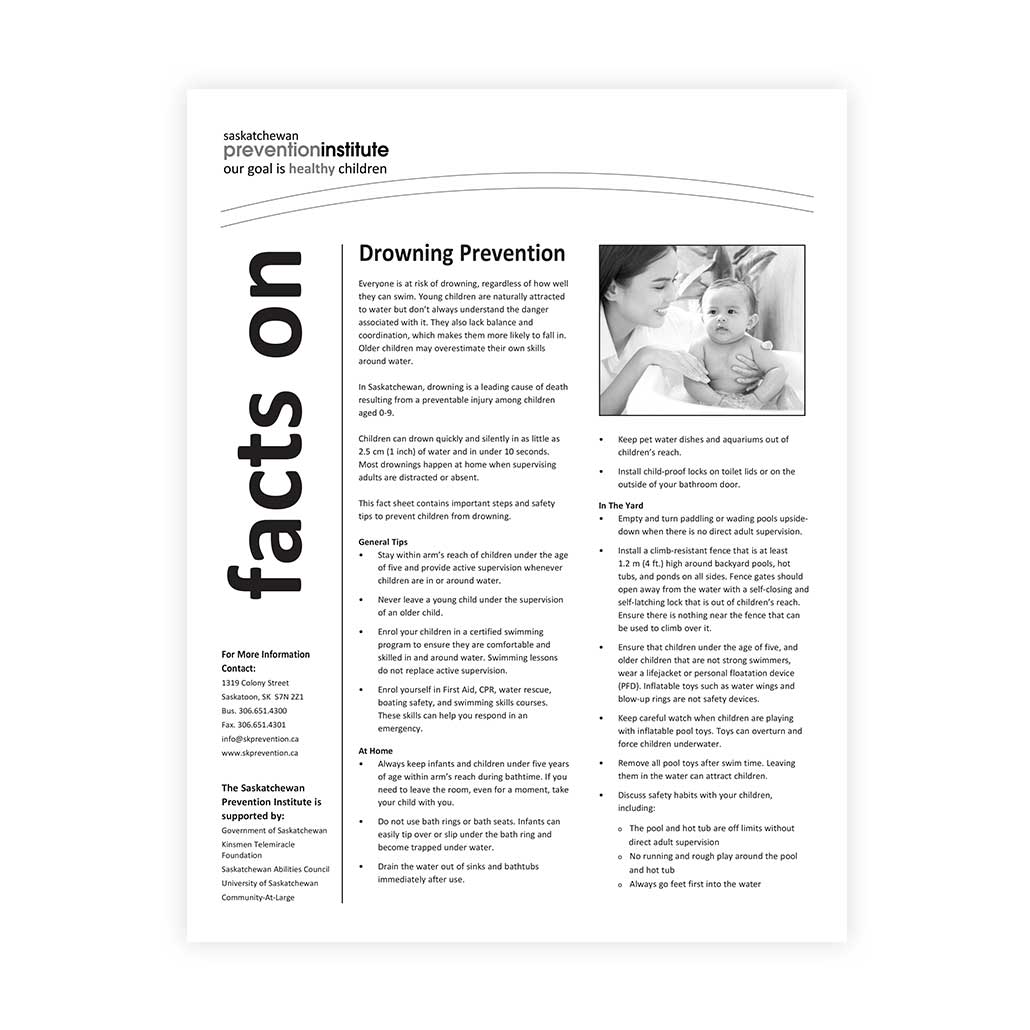
Drowning Prevention
Attributes to meet: PDF: Download File, Fact Sheets
Download File: condition met
Fact Sheet, Revised 2025
The fact sheet outlines water safety tips and drowning prevention strategies for children along with guidelines for lifejacket and personal floatation device (PFD) use. It outlines information for caregivers supervising children at home, in the yard, in a watercraft, and at the pool, lake, or beach.
Related products
-

Child and Youth Injury in Saskatchewan 1995-1999
Report, 2002
This report focuses on the most significant causes of injury-related hospitalizations and deaths for Saskatchewan children and youth. The most significant causes discussed in this report are falls, motor vehicle traffic, self-injury, drowning and choking, fire and flame, poison, motor vehicle pedestrian, sports, and assaults.
SKU: 4-006 -

Child Death Review in Canada: A National Scan
Report, 2016
This report provides information about current child death review processes that exist in each of the provinces and territories in Canada, based on interviews with key informants in each region. Particular attention is paid to those provinces with a coordinated, multi-disciplinary, provincial child death review process. Recommendations and advice for others initiating a child death review process are also included.
SKU: 2-460 -

How to Choose a Bicycle Helmet for a Child
Fact Sheet, Revised 2022
This fact sheet provides information to caregivers about bicycle helmet safety standards, the types of helmets, and how to adjust a helmet for proper fit.
NOTE: Remember to always refer to the bicycle helmet manufacturer’s instructions for information about the size, use, and expiry date (if specified) of the helmet.
SKU: 4-201 -

Gotta Brain Getta Helmet
Booklet, Revised 2024
This booklet provides safety information about helmet use for a variety of activities.
As part of the Gotta Brain Getta Helmet booklet, view this video featuring Savannah Smith, a motocross rider from Saskatchewan. Savannah shares information about her experiences, the importance of wearing a properly fitted helmet, and how to choose a helmet.
SKU: 4-220