
Prevention of HIV Infection in Adolescents
Attributes to meet: PDF: Download File, Reports
Download File: condition met
Report, 2015
Primary prevention of HIV infection in Saskatchewan youth is important, both for their own health and for the health of their future children. This review highlights the importance of HIV prevention for adolescents by summarizing information about common HIV risk behaviours in adolescence and examining ways to most effectively reduce the risk of infection.
Related products
-
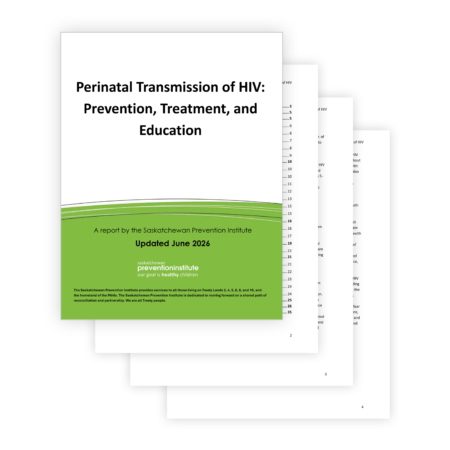
Perinatal Transmission of HIV: Prevention, Treatment, and Education
Report, Updated 2026
Saskatchewan continues to see high rates of new cases of human immunodeficiency virus (HIV) infection in comparison to the rest of Canada. A large number of these new cases are being identified in women of childbearing age.
Recognizing the importance of understanding HIV in the context of pregnancy, the Saskatchewan Prevention Institute conducted a review of the literature in this area. The review includes findings and recommendations on perinatal transmission, transmission prevention, barriers to prevention, and health promotion around these topics.
SKU: 7-501 -

HIV and Pregnancy – (Plains Cree Translation)
Poster, 2019
This poster states that women living with HIV can have healthy pregnancies and healthy babies. This poster was translated to Plains Cree by the Saskatchewan Indigenous Cultural Centre.
SKU: 7-101 -

Sexual Health Development Chart
Flipchart, Revised 2024
This resource is aimed at health professionals and childcare providers. It provides information and messages to promote sexual health in their interactions with children and families and to support parents as sexual health educators. The flipchart includes information for five age groups: Birth to Two Years; Two to Five Years; Five to Eight Years; Nine to Twelve Years; Thirteen to Sixteen Years.
SKU: 7-203 -

HIV and Pregnancy – A Guide to Care
Guide and Manual, Revised 2020
This guide covers such topics such as HIV/AIDS in Saskatchewan, modes of transmission of HIV, HIV testing during pregnancy, prenatal algorithm, HIV treatment and drug management, after-care for babies of HIV positive women, barriers to HIV transmission prevention and prenatal care, and motivational approaches.
For updated information about HIV/AIDS for health professionals, visit: https://www.canada.ca/en/public-health/services/diseases/hiv-aids/health-professionals.html.
For updated HIV order sets for Saskatchewan, including maternal and infant order sets, clinical forms, and discharge checklists, visit: https://www.saskhealthauthority.ca/intranet/health-provider-resources/clinical-resources/z-list-clinical-resources/maternalchildrens-health-resources/hiv-maternal-and-newborn-clinical-resources.
For updated information about infant feeding recommendations in Canada, including criteria for people living with HIV who want to breastfeed, visit: https://pubmed.ncbi.nlm.nih.gov/37008587/.
SKU: 7-008