

Child Death Review in Canada: A National Scan
Attributes to meet: PDF: Download File, Reports
Download File: condition met
Report, 2016
This report provides information about current child death review processes that exist in each of the provinces and territories in Canada, based on interviews with key informants in each region. Particular attention is paid to those provinces with a coordinated, multi-disciplinary, provincial child death review process. Recommendations and advice for others initiating a child death review process are also included.
Related products
-
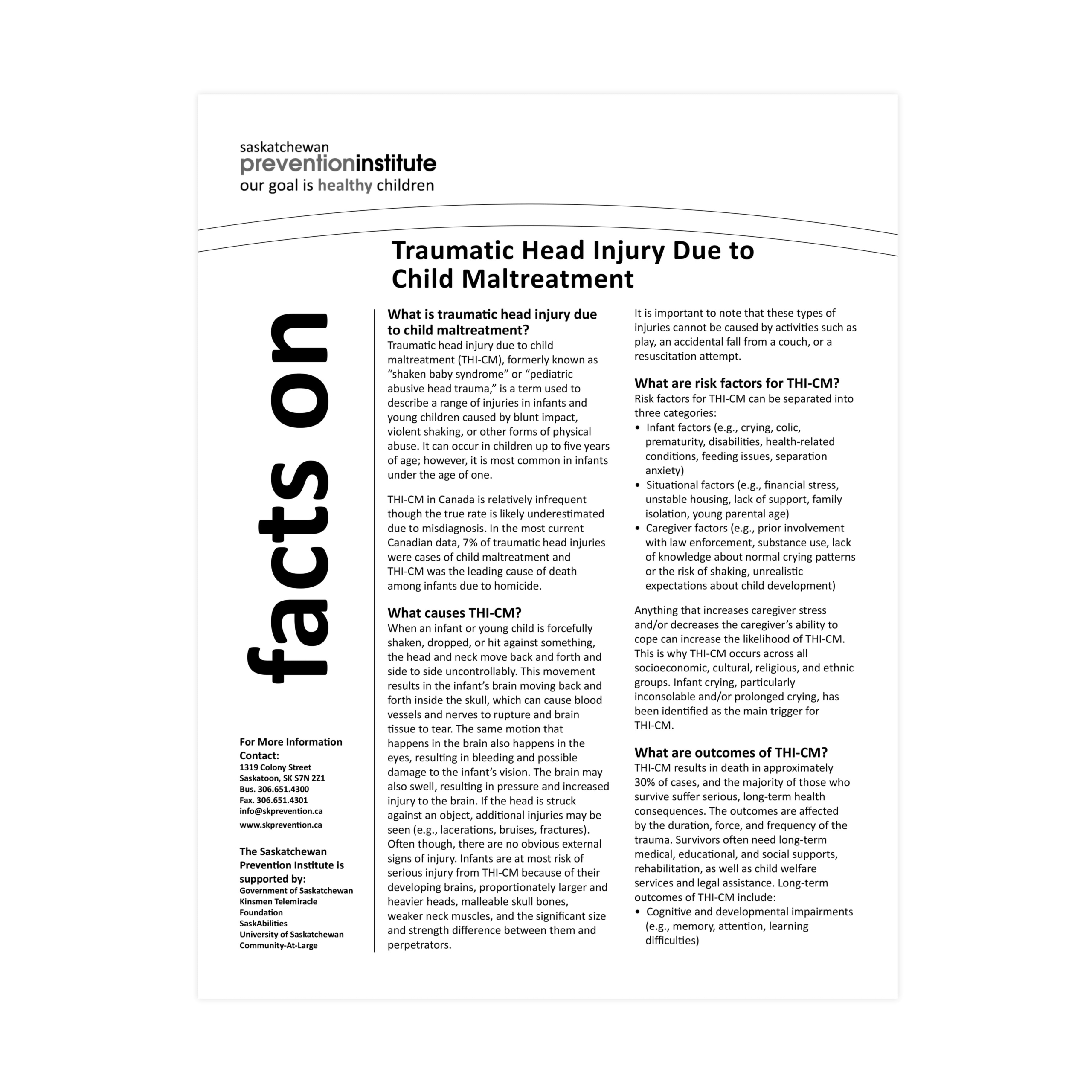
Traumatic Head Injury Due to Child Maltreatment
Fact Sheet, Updated 2026
Explains what traumatic head injury due to child maltreatment is, including how and why it happens, the long-term effects, and how it can be prevented. Aimed at health professionals and service providers who work with families. For information aimed at caregivers, see When Your Baby Can’t Stop Crying (resource 4-902).
SKU: 4-900 -

Infant Mortality in Saskatchewan: Evidence to Inform Public Health Practice
Report, 2009
This document was prepared to describe the relationship between modifiable risk factors and infant mortality. It is meant to provide guidance, strategies, and support to help expand or develop programs that may contribute to the reduction of infant mortality in Saskatchewan. It includes a review of the literature regarding prevalent risk factors associated with infant mortality, as well as identifying promising practices related to those modifiable risk factors.
SKU: 2-457 -

Bicycle Safety
Fact Sheet, Revised 2022
This fact sheet outlines general bicycle and helmet safety tips as well as important rules of the road. This resource is ideal for cyclists of all ages to prevent injuries while biking.
SKU: 4-202 -

Protecting the Brain
Fact Sheet, Revised 2019
The brain enables us to do everything that we do – breathe, walk, plan for our futures, and makes us who we are as individuals. It is important to understand how the brain works so we can protect it as best as possible.
SKU: 4-005