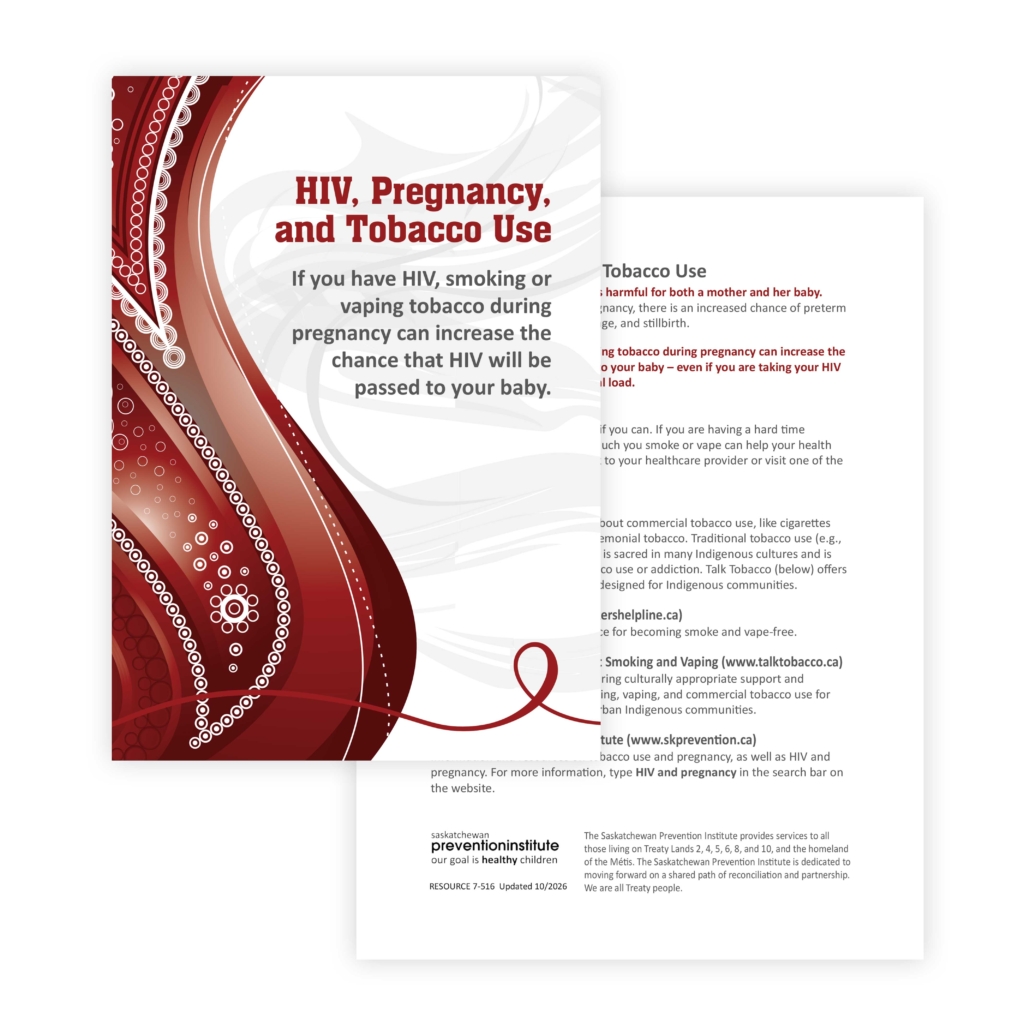
HIV, Pregnancy, and Tobacco Use
Attributes to meet: PDF: Information Cards, Order
Download File & Order: condition met
Information Card, Updated 2026
This information card explains that for people living with HIV, smoking or vaping commercial tobacco during pregnancy can increase the chances that HIV will be passed to the baby. Resources are listed to help pregnant people and those planning a pregnancy quit or reduce their tobacco use, including culturally safe support for Indigenous communities.
Related products
-

Group Prenatal Care Lit Review
Report, 2016
Group prenatal care is a model of group where eight to twelve women of similar gestational age meet as a group with their healthcare provider for 90-120 minutes of regularly scheduled appointments, starting in their second trimester and continuing throughout their pregnancy. During these appointments, each woman has a brief individual physical assessment with the healthcare provider and then participates in a group discussion led by a healthcare provider. All prenatal care is provided in this group setting, combining the usual physical assessment with peer support and increased time for education about healthy pregnancy. This report examines current research on group prenatal care to assess if it is a good model of care for Saskatchewan and if there is an improvement in birth outcomes and breastfeeding rates associated with using this model of care compared to individual prenatal care. Birth outcomes examined in this report are gestational age at birth, preterm birth, and low birth weight.
SKU: 2-903 -

Sexually Transmitted and Blood-Borne Infections (STBBIs): What You Need to Know
Brochure, Revised 2026
Designed for youth, this brochure provides evidence-based information on sexually transmitted and blood-borne infections (STBBIs). It covers what STBBIs are, how they are spread, chances of getting an STBBI, ways to reduce risk, when to get tested, and stigma related to STBBIs.
SKU: 7-002 -

Common Non-prescription Medications in Pregnancy
Fact Sheet, Revised 2021
Non-prescription medications, sometimes referred to as over-the-counter or OTC medications, are those that can be purchased without having a doctor’s prescription. This fact sheet provides information on common OTC medications such as antacids, antihistamines, laxatives, cough and cold medications, herbal products, and many more that are used in pregnancy.
SKU: 2-251 -

Fetal Development
Poster, 2008
These 8.5 x 11 inch posters, developed by Childbirth Graphics, assist healthcare professionals in discussing alcohol use with their patients. Although these posters do not focus on FASD, they can be used to help patients understand that alcohol is one of many factors which can impact the development of the fetus.
Audience: Healthcare Professionals and their PatientsPlease note: This resource is a pad of 50 fact sheets. An order quantity of 1 equals 50 fact sheets.SKU: 3-143