
Protect Your Baby’s Head Shape: Preventing Flat Spots on Your Baby’s Head
Attributes to meet: PDF: Brochures, Order
Download File & Order: condition met
Brochure, Revised 2023
This brochure provides parents and caregivers with information on positional plagiocephaly, or “flat head”. Information includes how to prevent flat spots and what to do if a flat spot is found on baby’s head.
Related products
-

Safe Sleep Evidence Summary
Report, 2017
This evidence summary summarizes evidence based guidelines on safe sleep and is intended for use by policy makers, healthcare providers, and service providers.
SKU: 2-438 -

Child Death Review in Canada: A National Scan
Report, 2016
This report provides information about current child death review processes that exist in each of the provinces and territories in Canada, based on interviews with key informants in each region. Particular attention is paid to those provinces with a coordinated, multi-disciplinary, provincial child death review process. Recommendations and advice for others initiating a child death review process are also included.
SKU: 2-460 -

How to Choose a Bicycle Helmet for a Child
Fact Sheet, Revised 2022
This fact sheet provides information to caregivers about bicycle helmet safety standards, the types of helmets, and how to adjust a helmet for proper fit.
NOTE: Remember to always refer to the bicycle helmet manufacturer’s instructions for information about the size, use, and expiry date (if specified) of the helmet.
SKU: 4-201 -
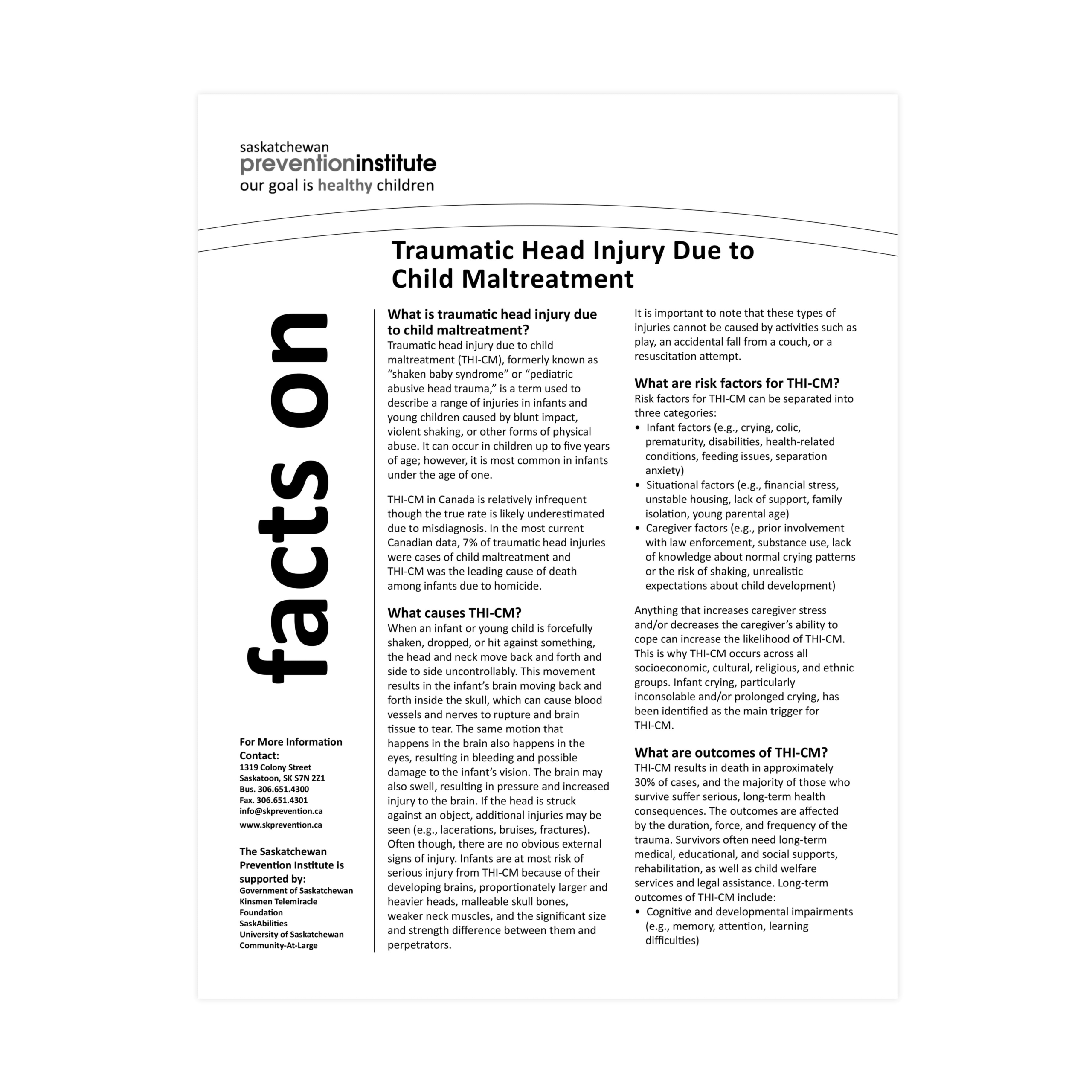
Traumatic Head Injury Due to Child Maltreatment
Fact Sheet, Updated 2026
Explains what traumatic head injury due to child maltreatment is, including how and why it happens, the long-term effects, and how it can be prevented. Aimed at health professionals and service providers who work with families. For information aimed at caregivers, see When Your Baby Can’t Stop Crying (resource 4-902).
SKU: 4-900