

Protect Your Baby’s Head Shape: Preventing Flat Spots on Your Baby’s Head
Attributes to meet: PDF: Brochures, Order
Download File & Order: condition met
Brochure, Revised 2023
This brochure provides parents and caregivers with information on positional plagiocephaly, or “flat head”. Information includes how to prevent flat spots and what to do if a flat spot is found on baby’s head.
Related products
-

Safe Sleep Evidence Summary
Report, 2017
This evidence summary summarizes evidence based guidelines on safe sleep and is intended for use by policy makers, healthcare providers, and service providers.
SKU: 2-438 -

How to Choose a Bicycle Helmet for a Child
Fact Sheet, Revised 2022
This fact sheet provides information to caregivers about bicycle helmet safety standards, the types of helmets, and how to adjust a helmet for proper fit.
NOTE: Remember to always refer to the bicycle helmet manufacturer’s instructions for information about the size, use, and expiry date (if specified) of the helmet.
SKU: 4-201 -
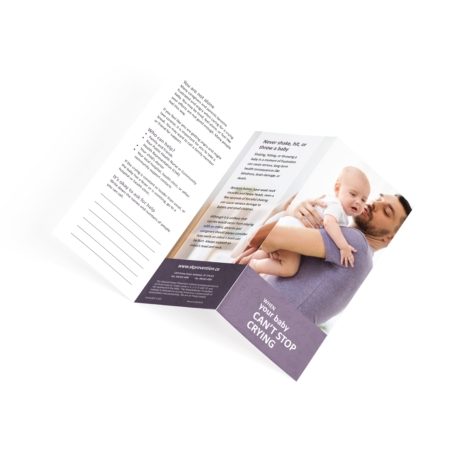
When Your Baby Can’t Stop Crying
Brochure, Revised 2025
Although infant crying is normal, it can be very frustrating for parents and caregivers. This brochure identifies strategies for dealing with a crying infant, as well as strategies for handling caregivers’ frustration.
For information aimed at health professionals and service providers, see Traumatic Head Injury Due to Child Maltreatment (resource 4-900).
SKU: 4-902 -

Your Activity Guide for Teaching Bike Safety Skills
Guide, Revised 2020
This booklet is for any individual to use in educating children and youth about bicycle safety. These nine activities are designed for teaching bike safety skills for children ages 5 – 12. Included are speaking notes, notes to the educator, items required for the activities, and tools to support the activity (e.g., diagrams and photos). This booklet will help individuals focus on the importance of safe cycling through education.
SKU: 4-217