
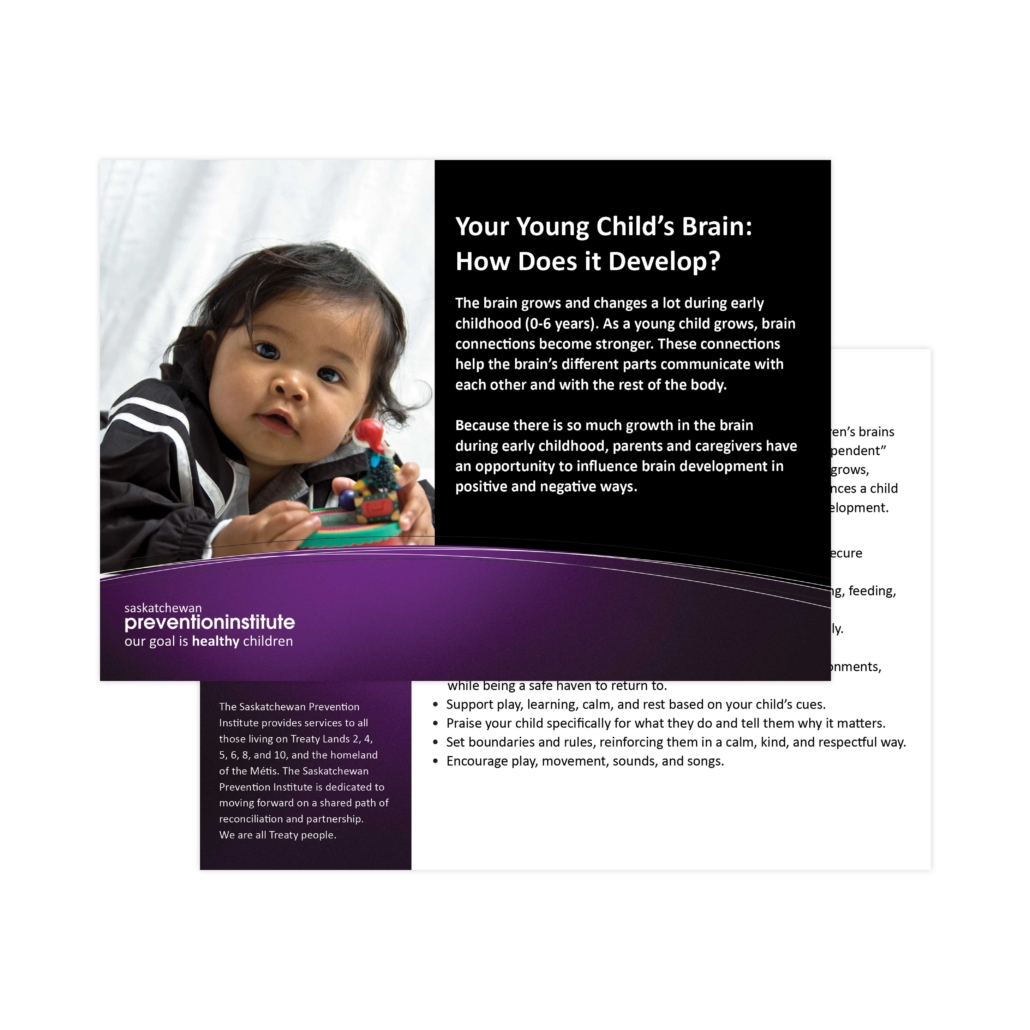
Your Young Child’s Brain: How Does It Develop?
Attributes to meet: PDF: Information Cards, Order
Download File & Order: condition met
Information Card, Updated 2026
Written in plain language, this information card provides basic information about the importance of brain development during the early years. Practical tips to increase opportunities for children’s healthy development are included.
Related products
-

Fetal Development
Poster, 2008
These 8.5 x 11 inch posters, developed by Childbirth Graphics, assist healthcare professionals in discussing alcohol use with their patients. Although these posters do not focus on FASD, they can be used to help patients understand that alcohol is one of many factors which can impact the development of the fetus.
Audience: Healthcare Professionals and their PatientsPlease note: This resource is a pad of 50 fact sheets. An order quantity of 1 equals 50 fact sheets.SKU: 3-143 -

My Curious Brain
Booklet, 2019
My Curious Brain is a fun, interactive, and educational book for parents and caregivers to teach their kids about how the brain works. When parents and caregivers have a greater understanding of how the brain works, they will better understand how to support their child and promote healthy brain development. With a greater awareness of how the brain works and with supportive caregivers, children can develop self-regulation skills and strategies to help them effectively deal with stress.
SKU: 5-505 -

What Have You Heard About Maternal Mental Health (Pamphlet)
Pamphlet, 2023
This pamphlet provides information about maternal/perinatal mental health, self-care tips for parents, and a list of organizations that provide information and support related to mental health before, during, and/or after pregnancy.
SKU: 2-110 -

Edinburgh Postpartum Depression Scale (EPDS) Screening and Care Guide
Guide and Manual, 2012
The EPDS Screening and Care Guide provides healthcare providers with score interpretation and care guide to use when screening pregnant and postpartum women for depression and anxiety using the Edinburgh Postpartum Depression Scale (EPDS). It also includes guidelines for medical management when maternal mental health is of concern, contact information for Saskatchewan Healthline and Saskatchewan Drug Information Services, and a space for relevant local contact information. On the reverse side of the form there is a brief description of maternal depression including common symptoms, guidelines for screening, and the EPDS questions.
* For an updated version of the Maternal Mental Health Edinburgh Postnatal Depression Scale (EPDS) Screening and Care Guide available through the Saskatchewan Ministry of Health, please visit https://www.ehealthsask.ca/services/resources/Resources/EPDS-screening-2019.pdfSKU: 2-104