
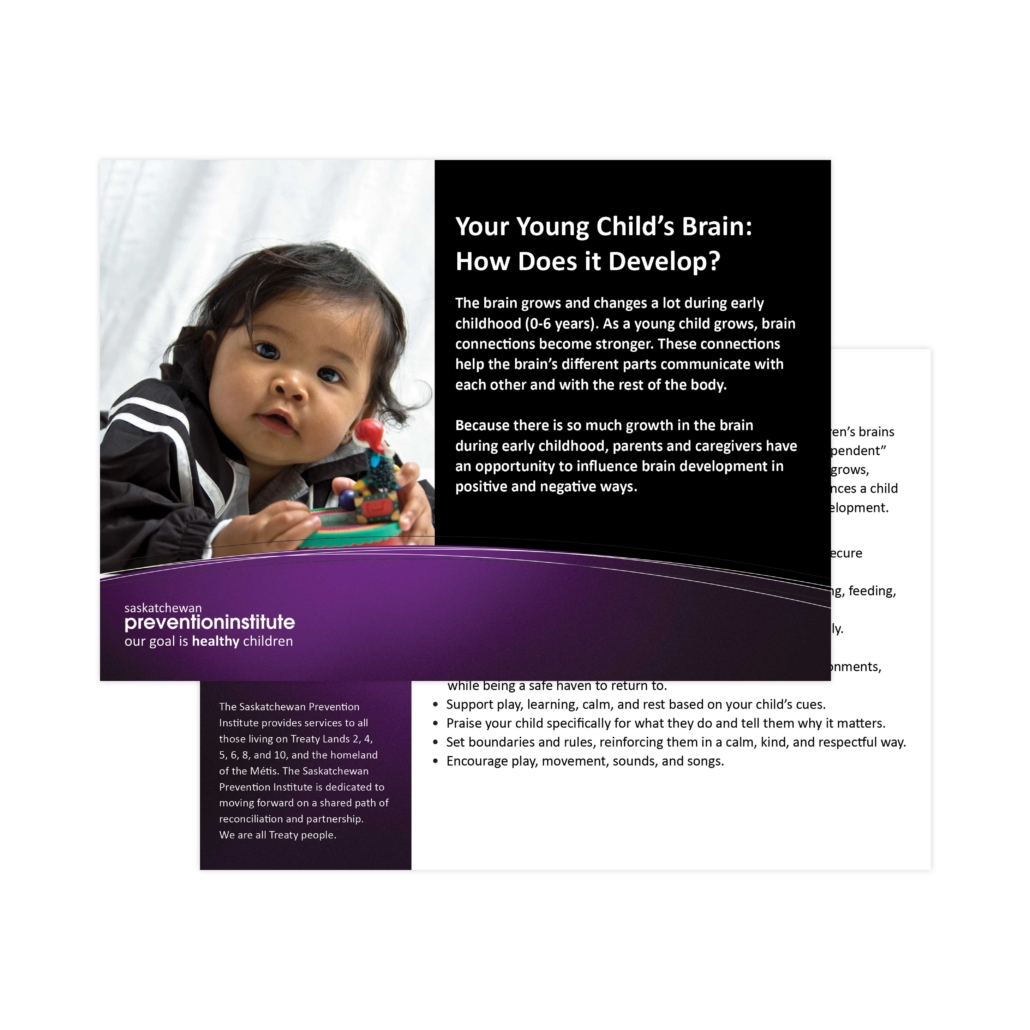
Your Young Child’s Brain: How Does It Develop?
Attributes to meet: PDF: Information Cards, Order
Download File & Order: condition met
Information Card, Updated 2026
Written in plain language, this information card provides basic information about the importance of brain development during the early years. Practical tips to increase opportunities for children’s healthy development are included.
Related products
-

Fetal Development
Poster, 2008
These 8.5 x 11 inch posters, developed by Childbirth Graphics, assist healthcare professionals in discussing alcohol use with their patients. Although these posters do not focus on FASD, they can be used to help patients understand that alcohol is one of many factors which can impact the development of the fetus.
Audience: Healthcare Professionals and their PatientsPlease note: This resource is a pad of 50 fact sheets. An order quantity of 1 equals 50 fact sheets.SKU: 3-143 -

Promising Practices in the Mitigation of the Impacts of Adverse Childhood Experiences (ACES) in Children Ages 0 to 6
Report, 2022
Adverse childhood experiences (ACEs) are childhood events that cause harm or distress and, as a result, disrupt the child’s health and development. The purpose of this report is to define ACEs and their impact on development, health, and well-being; describe how ACEs are identified in children ages 0 to 6; and investigate evidence-based practices being used with children ages 0 to 6 and parent/caregiver-child dyads to mitigate (make less severe or harmful) the impacts of ACEs in childhood and beyond.
“In November 2022 an Executive Summary was added to the report”.
SKU: 9-000 -

Safe Sleep for Your Baby: Lower the Risk of SIDS
Brochure, Revised 2019
This brochure outlines safe sleeping habits for babies to help reduce the risk of Sudden Infant Death Syndrome (SIDS). It also provides information on breastfeeding and the importance of supervised “tummy time”.
SKU: 2-437 -

Maternal Mental Health
Fact Sheet, 2013
These fact sheets are intended as an information resource for healthcare providers or other individuals who would like further information on maternal depression. It is more detailed than the Information Card. On the back of the fact sheet is the Edinburgh Postpartum Depression Scale (EPDS), a depression screen that can be done with a woman or can be provided to a woman to complete on her own. The fact sheet can be referred to when discussing maternal depression with women and their families, or used to share information with your colleagues.
* For an updated version of the Maternal Mental Health Edinburgh Postnatal Depression Scale (EPDS) Screening and Care Guide available through the Saskatchewan Ministry of Health, please visit https://www.ehealthsask.ca/services/resources/Resources/EPDS-screening-2019.pdfSKU: 2-102