
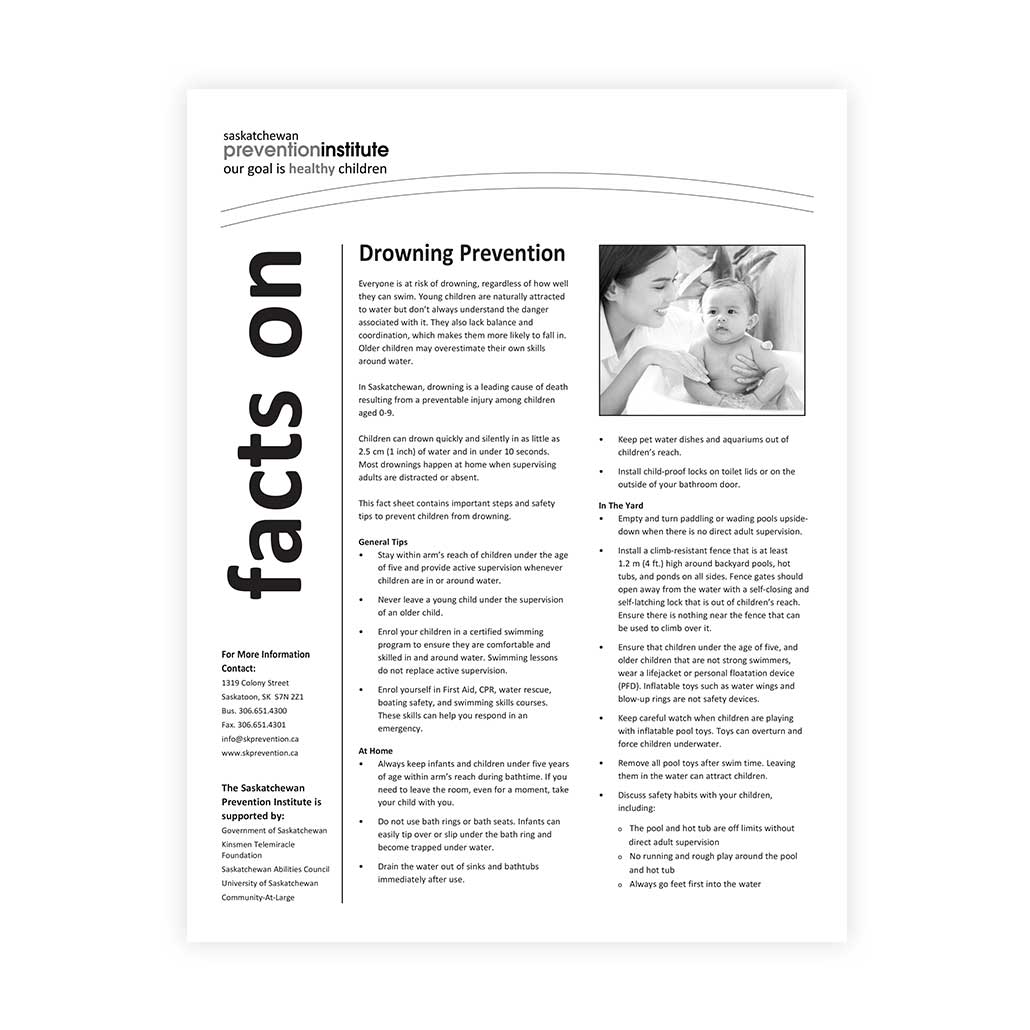
Drowning Prevention
Attributes to meet: PDF: Download File, Fact Sheets
Download File: condition met
Fact Sheet, Revised 2025
The fact sheet outlines water safety tips and drowning prevention strategies for children along with guidelines for lifejacket and personal floatation device (PFD) use. It outlines information for caregivers supervising children at home, in the yard, in a watercraft, and at the pool, lake, or beach.
Related products
-

Home Safety Tips: 1 to 4 Years
Booklet, Revised 2025
All children depend on the adults around them to provide safe, healthy environments to learn, grow, and develop new skills. This booklet will support caregivers in preparing for each stage of child development, to better predict and prevent injuries to children from 1 to 4 years of age.
Safety tips are organized by activity, and address the following topics: safe sleep, drowning, burns, scalds, choking, poisoning, bike and wheel safety, car seats, and pedestrian safety.
Also available: Home Safety Tips: Birth to 1 Year, and Home Safety Tips: 5 to 9 YearsSKU: 4-024 -

Protect Your Baby’s Head Shape: Preventing Flat Spots on Your Baby’s Head
Brochure, Revised 2023
This brochure provides parents and caregivers with information on positional plagiocephaly, or “flat head”. Information includes how to prevent flat spots and what to do if a flat spot is found on baby’s head.
SKU: 4-101 -

Home Safety Tips: Birth to 1 Year
Booklet, Revised 2025
All children depend on the adults around them to provide safe, healthy environments to learn, grow, and develop new skills. This booklet will support caregivers in preparing for each stage of child development, to better predict and prevent injuries to children from birth to 1 year of age.
Safety tips are included on the following topics: safe sleep, coping with crying, burns, scalds, drowning, falls, choking, and car seats.
Also available: Home Safety Tips: 1 to 4 Years, and Home Safety Tips: 5 to 9 YearsSKU: 4-023 -

When Your Baby Can’t Stop Crying
Brochure, Revised 2025
Although infant crying is normal, it can be very frustrating for parents and caregivers. This brochure identifies strategies for dealing with a crying infant, as well as strategies for handling caregivers’ frustration.
For information aimed at health professionals and service providers, see Traumatic Head Injury Due to Child Maltreatment (resource 4-900).
SKU: 4-902