

Safe Sleep for Your Baby: Lower the Risk of SIDS
Attributes to meet: PDF: Brochures, Order
Download File & Order: condition met
Brochure, Revised 2019
This brochure outlines safe sleeping habits for babies to help reduce the risk of Sudden Infant Death Syndrome (SIDS). It also provides information on breastfeeding and the importance of supervised “tummy time”.
Related products
-

Childhood Exposure to Intimate Partner Violence: A Literature Review
Report, 2024
Childhood exposure to intimate partner violence (IPV) can have both short- and long-term negative impacts on the health and well-being of children that can persist across generations. This literature review details prevalence, child perspectives, effects of exposure, and intergenerational transmission of violence. Information about protective factors and intervention strategies is also provided.
For a related literature review focused on intimate partner violence during pregnancy, please visit www.skprevention.ca/resource-catalogue/pregnancy/intimate-partner-violence-ipv-during-pregnancy-a-literature-review/.
SKU: 8-900 -

Protect Your Baby’s Head Shape: Preventing Flat Spots on Your Baby’s Head
Brochure, Revised 2023
This brochure provides parents and caregivers with information on positional plagiocephaly, or “flat head”. Information includes how to prevent flat spots and what to do if a flat spot is found on baby’s head.
SKU: 4-101 -
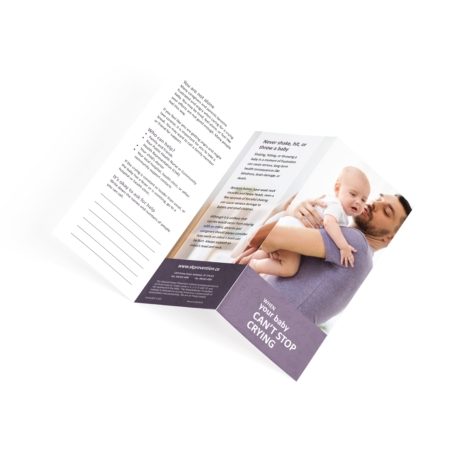
When Your Baby Can’t Stop Crying
Brochure, Revised 2025
Although infant crying is normal, it can be very frustrating for parents and caregivers. This brochure identifies strategies for dealing with a crying infant, as well as strategies for handling caregivers’ frustration.
For information aimed at health professionals and service providers, see Traumatic Head Injury Due to Child Maltreatment (resource 4-900).
SKU: 4-902 -
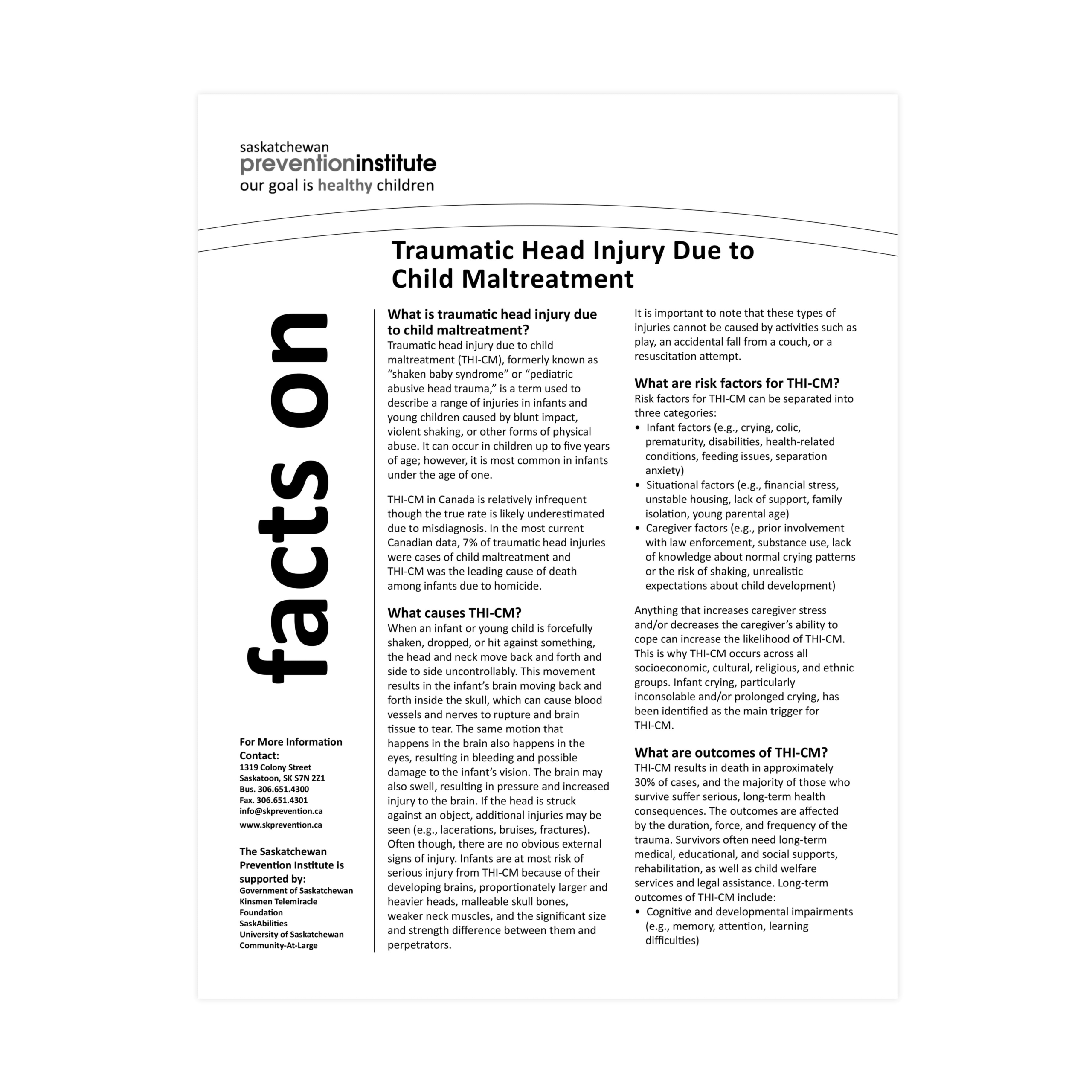
Traumatic Head Injury Due to Child Maltreatment
Fact Sheet, Updated 2026
Explains what traumatic head injury due to child maltreatment is, including how and why it happens, the long-term effects, and how it can be prevented. Aimed at health professionals and service providers who work with families. For information aimed at caregivers, see When Your Baby Can’t Stop Crying (resource 4-902).
SKU: 4-900